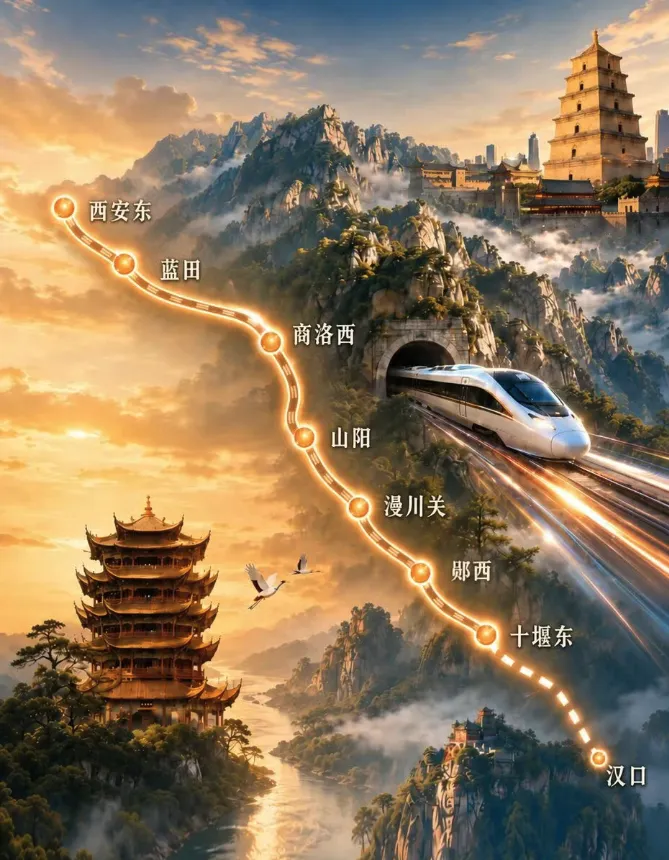
Today, June 30, 2026, the Xi'an-Shiyan High-Speed Railway (Xishi HSR) officially starts operation, alongside the opening of the brand-new Xi’an East Railway Station. The direct high-speed rail corridor between Wuhan and Xi’an is now fully connected.
From today, you no longer need to detour via Zhengzhou, Henan when traveling from Wuhan to Xi’an. The fastest trip takes only 2 hours and 41 minutes. This new straight high-speed artery between Northwest and Central China will make business trips and cross-province travels much faster and more convenient.
The Xishi High-Speed Railway stretches 257 kilometers with a designed maximum speed of 350 km/h. It runs through the Qinling Mountains, with bridges and tunnels accounting for over 90% of the total route, making it one of the most challenging mountain high-speed railways built in China.
Starting from Xi’an East Station, the railway passes Lantian, Shangluoxi, Shanyang and Manchuanguan in Shaanxi Province, and Yunxi in Hubei Province, and finally connects to Shiyan East Station of the already operational Wuhan-Shiyan High-Speed Railway. There are 7 stations along the line, 6 of which are newly built. Seamlessly connected with the Wuhan-Shiyan HSR, the route links multiple cities including Wuhan, Xiaogan, Xiangyang, Shiyan, Shangluo and Xi’an.
In the initial operation stage, 29 pairs of EMU trains run daily, including 25 pairs of cross-line through trains.
The railway adopts a market-based floating ticket price system. Please refer to real-time information on 12306 for exact prices.
The only official ticketing channels are the Railway 12306 mobile app and official website. Foreign nationals can purchase tickets with valid passports under the real-name system.
More efficient business trips
Upgraded cultural travel route
Comfortable travel experience
The Qinling Mountains are no longer a barrier on the road. In just over two hours, you can travel from the river city Wuhan to Xi’an, the ancient capital of 13 dynasties. Take this brand-new high-speed railway to start your journey through the mountains, rivers and culture of Qin and Chu regions.